
Designing for Reliability in Extreme Environments
Designing for Reliability in Extreme Environments
Designing for Reliability in Extreme Environments
Designing for Reliability in Extreme Environments
In demanding industrial and OEM applications, fan selection is rarely just about airflow or efficiency. Real-world operating conditions such as heat, dust, moisture, and continuous duty cycles, often expose the gap between a fan’s claimed specifications and its actual field performance.
For mechanical and electrical engineers and OEM design teams, understanding how fan design choices affect uptime is critical to real world performance of the fan. This piece looks at why operating range alone is insufficient, identifies common failure modes in harsh environments, and outlines the design factors that influence long-term reliability and efficiency.
Why “Operating Range” Is Not the Same as Real-World Survivability
Datasheets often define operating ranges in clean, controlled laboratory conditions. While these ranges are useful, they rarely reflect the cumulative stress imposed by real installations that will inevitably encounter conditions that are not controlled, especially in industrial, outdoor, or high-duty-cycle environments.
A fan rated for a maximum temperature of 70°C may survive short-term exposure but fail prematurely when subjected to continuous thermal cycling, dust ingestion, or vibration. Survivability depends not just on peak limits, but on how components respond to repeated stress over time and that is why simply relying on the “operation range” is not enough.
Common Extreme Environments and Failure Modes
High Temperature and Thermal Cycling
Elevated ambient temperatures accelerate lubricant breakdown, reduce motor insulation life, and increase bearing wear. Thermal cycling, repeated heating and cooling, can further stress solder joints, adhesives, and material interfaces, similar to the wear and tear on the starter of your car over time.
Common failures include:
Bearing seizure due to lubricant degradation or leaks
Motor winding insulation breakdown
Cracking or loosening of mechanical interfaces
Dust, Moisture, and Corrosive Exposure
Dust and particulates can infiltrate bearings and motors, leading to abrasion and imbalance. Moisture introduces corrosion risks, while chemicals or salt-laden air can rapidly degrade untreated metals and coatings.
Common failures include:
Increased vibration from dust buildup
Electrical shorts from condensation or foreign object debris
Corrosion of housings, fasteners, and impellers
Shock, Vibration, and Orientation Challenges
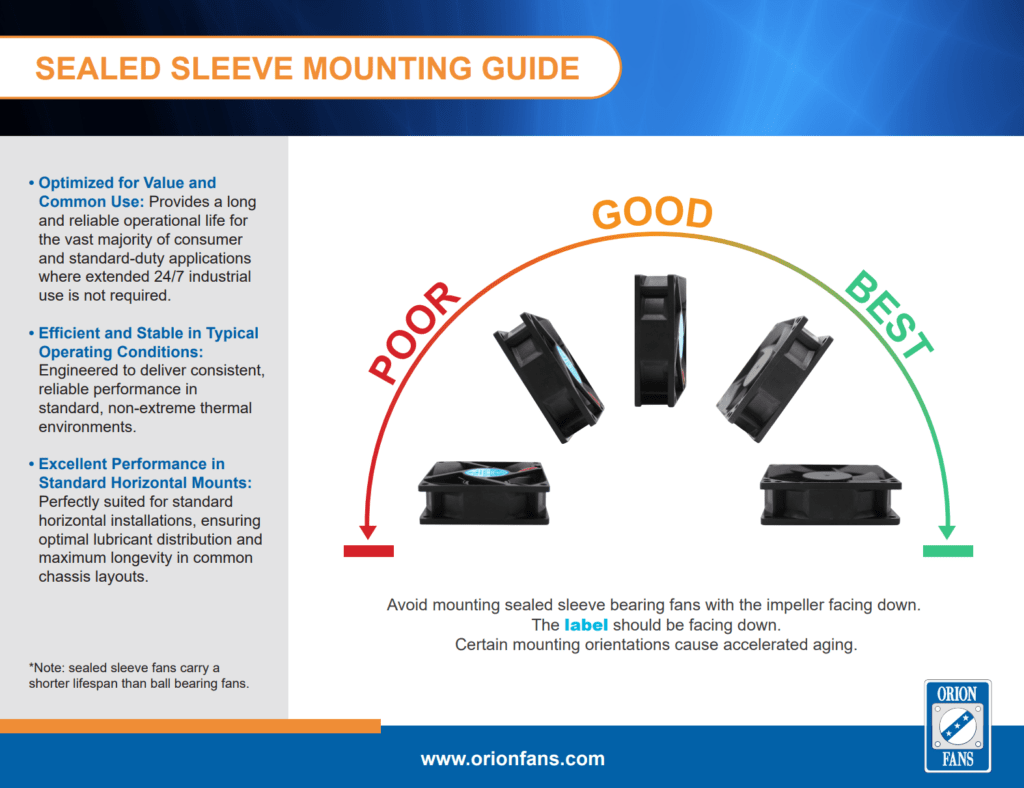
Applications involving mobile equipment, transportation, or industrial machinery subject fans to constant vibration and occasional shock loads. Orientation also matters, as some bearing types perform differently in vertical versus horizontal mounting such as sleeve bearing fans. Even sealed sleeve fans may leak lubricant when mounted incorrectly resulting in faster corrosion of important fan components.
Common failures include:
Bearing fatigue from vibration without dampeners
Connector and lead wire damage
Premature wear due to unsupported orientations
For a quick look at the acceptable mounting orientations for sealed sleeve fans, see this guide.
Key Design Factors That Improve Reliability
Motor and Bearing Selection
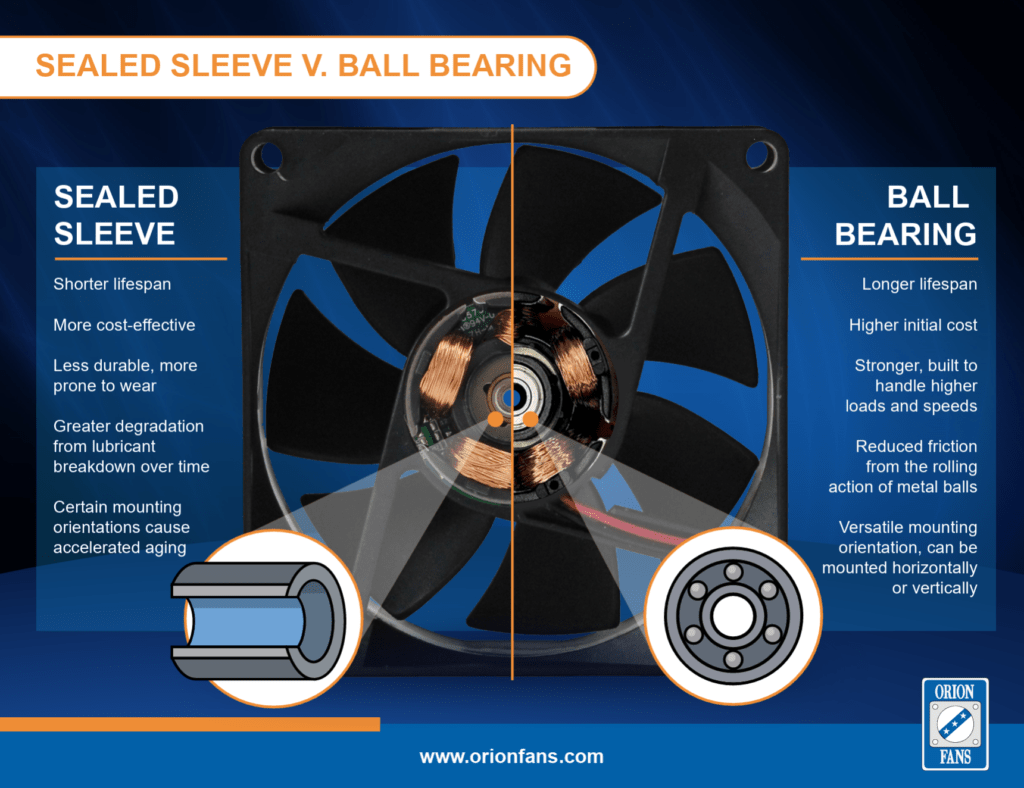
Motor and bearing type are among the most critical reliability decisions. Ball bearings generally outperform sleeve bearings in high-temperature, high-vibration, or variable-orientation environments. Motor winding insulation class and thermal margins also play a major role in long-term survivability.
Class A insulation (105 °C) is typically used in cost-sensitive, light-duty applications with stable ambient conditions, such as consumer electronics or office equipment.
Class B insulation (130 °C) supports higher operating temperatures and is commonly found in commercial and light industrial systems where moderate heat rise and continuous operation are expected.
Class F insulation (155 °C) provides greater thermal headroom for harsh environments, including industrial automation, outdoor enclosures, and equipment exposed to elevated ambient temperatures or restricted airflow, where sustained reliability under thermal stress is required.
Materials, Coatings, and Ingress Protection
Material choice directly affects resistance to corrosion and fatigue. Aluminum, stainless steel, engineered plastics, and protective coatings can dramatically extend service life when properly matched to the environment. Ingress protection (IP) ratings help mitigate dust and moisture exposure but must be validated for the specific application to ensure adequate protection.
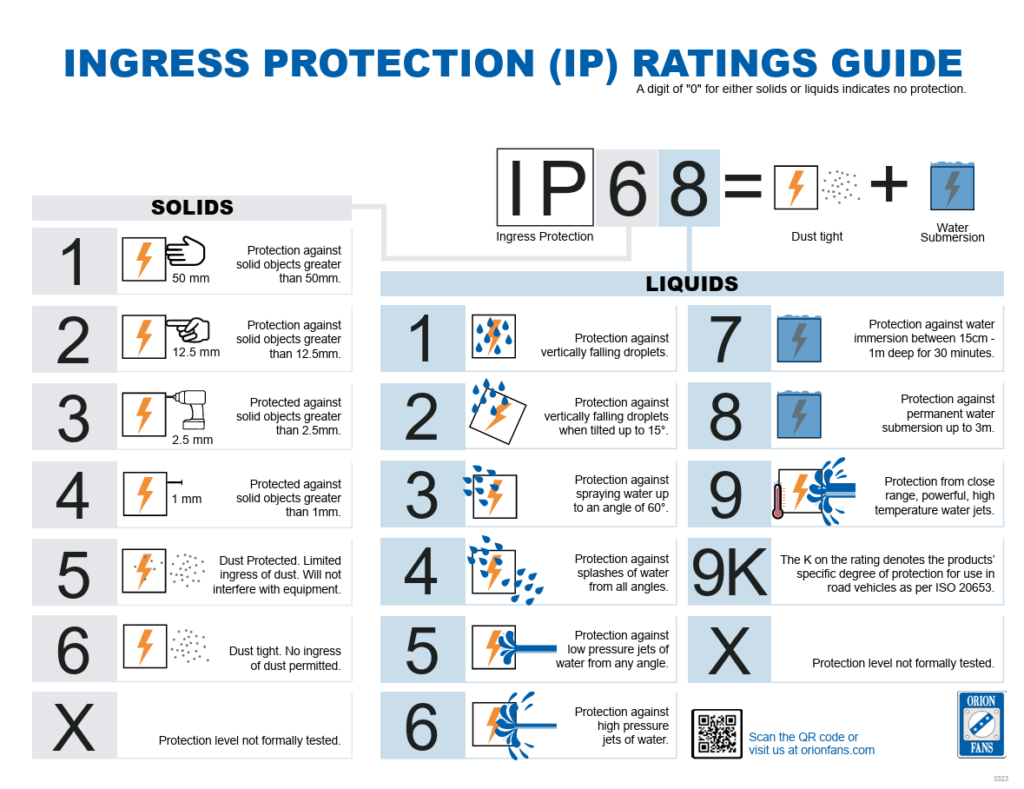
These ratings range from basic protection against incidental contact (IP20) to dust-tight and water-resistant designs suitable for washdown or outdoor use (IP65–IP67). In real-world applications, selecting the correct IP rating is critical, equipment exposed to airborne particulates, humidity, direct water spray or other liquids in industrial, agricultural, or outdoor environments demands higher protection levels such as IP68 or IP69K. However, IP ratings alone do not guarantee long-term reliability, they must be validated in the actual operating conditions, accounting for temperature extremes, pressure washing practices, and chemical exposure that can deteriorate seals and enclosures over time.
For a quick review of IP ratings and what they mean, check out our guide.
Below are also two great video reviews on IP68 and IP69K rated fans.
Derating and Safety Margins
Operating a fan continuously at its maximum rated limits significantly reduces lifespan. Intentional derating, running below maximum speed, temperature, or load, can multiply service life and improve overall system reliability.
Design Tradeoffs and Cost Implications
Improving reliability often increases upfront cost through higher-grade materials, better bearings, or enhanced protection. However, these costs are frequently outweighed by reduced downtime, lower warranty exposure, and longer maintenance intervals.
The key is balancing performance requirements with lifecycle cost, rather than optimizing solely for unit price.
When to Engage Application Engineering Early
Early collaboration with application engineering teams helps identify environmental risks before designs are finalized. Providing details such as duty cycle, ambient conditions, orientation, and expected lifespan allows for informed tradeoffs and avoids costly redesigns later.
Summary Checklist for Designing Fans in Harsh Environments
Define continuous operating conditions, not just peak limits
Account for thermal cycling, not just ambient temperature
Select bearings and motors appropriate for vibration and orientation
Evaluate dust, moisture, and corrosion exposure realistically
Apply derating to extend service life
Consider total cost of ownership, not just component cost
Engage application engineering early in the design process
Designing for harsh environments requires moving beyond datasheet specifications and focusing on how real-world conditions affect long-term performance. With the right design choices, fans can deliver reliable airflow and consistent uptime.